How to Calculate CGPA and Convert It to Percentage (With Examples)
How CGPA is calculated from credits and grade points, and how to convert it to percentage with the CBSE, VTU and 10-point formulas, with worked examples.
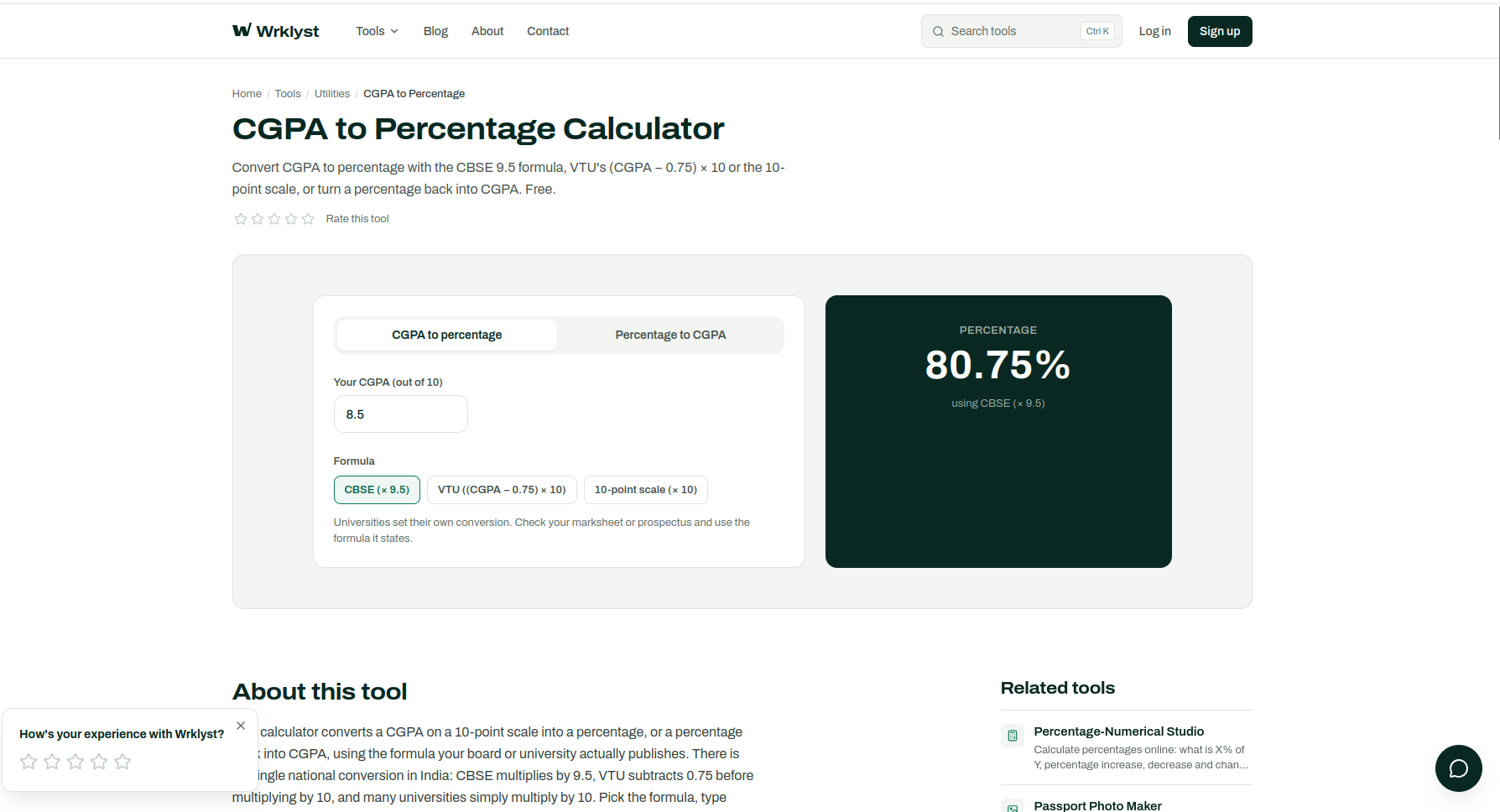
CGPA is the credit-weighted average of the grade points you have earned across every semester so far, on a 10-point scale. Turning it into a percentage takes one formula, but which formula depends on who awarded the grade: CBSE multiplies by 9.5, VTU uses (CGPA − 0.75) × 10, and many universities simply multiply by 10. That is why a CGPA of 8.5 can honestly be 80.75%, 77.5% or 85%.
This guide works through both halves with real numbers: how SGPA and CGPA are calculated from your grades, how each conversion formula works and where it comes from, a conversion table, and the mistakes that cause trouble on application forms. If you just want the answer, the CGPA to Percentage calculator converts either way and names the formula it used.
CGPA, SGPA and GPA: what the terms mean
- Grade point: the number a letter grade is worth on the 10-point scale, for example 9 for an A+.
- SGPA (Semester Grade Point Average): the credit-weighted average of your grade points for one semester.
- CGPA (Cumulative Grade Point Average): the credit-weighted average across all semesters completed so far. Your final CGPA covers the whole degree.
- GPA: a general term. In India it usually means SGPA or CGPA on a 10-point scale; in the US it means a 4-point scale, which does not convert to the Indian one by simple arithmetic.
The 10-point grading scale
Most Indian universities follow the model scale the UGC set out for the Choice Based Credit System, sometimes with small changes. The marks needed for each grade vary from one university to another, so check your own regulations for those.
| Letter grade | Meaning | Grade points |
|---|---|---|
| O | Outstanding | 10 |
| A+ | Excellent | 9 |
| A | Very good | 8 |
| B+ | Good | 7 |
| B | Above average | 6 |
| C | Average | 5 |
| P | Pass | 4 |
| F | Fail | 0 |
How to calculate SGPA
Multiply each course's grade points by its credits, add those products up, and divide by the total credits for the semester.
SGPA = Σ (credits × grade points) ÷ Σ credits
Here is a worked example for one semester:
| Course | Credits | Grade | Grade points | Credits × points |
|---|---|---|---|---|
| Mathematics | 4 | A+ | 9 | 36 |
| Physics | 4 | A | 8 | 32 |
| Programming | 3 | O | 10 | 30 |
| English | 2 | B+ | 7 | 14 |
| Physics lab | 2 | A | 8 | 16 |
| Total | 15 | 128 |
SGPA = 128 ÷ 15 = 8.53. Notice that the 4-credit Mathematics course moves the result twice as much as the 2-credit English course. That is the whole point of weighting by credits.
How to calculate CGPA
CGPA uses exactly the same idea across semesters: add up all the credit-weighted grade points you have earned, and divide by all the credits you have taken.
CGPA = Σ (credits × grade points, all semesters) ÷ Σ credits, all semesters
Suppose semester 1 is the one above (128 points over 15 credits) and semester 2 has 20 credits with an SGPA of 7.80, which is 156 points. Then:
CGPA = (128 + 156) ÷ (15 + 20) = 284 ÷ 35 = 8.11
The simple average of the two SGPAs would be (8.53 + 7.80) ÷ 2 = 8.17, which is wrong. Averaging SGPAs only gives the right answer when every semester carries the same number of credits, and it is the most common mistake people make when they work out a CGPA by hand.
How to convert CGPA to percentage
There is no national formula. Each board or university publishes its own, usually on the back of the grade card or in its examination regulations. These are the three you will meet most often, each worked out for a CGPA of 8.5.
CBSE: percentage = CGPA × 9.5
8.5 × 9.5 = 80.75%. CBSE chose the factor from its own results: it averaged the marks of students in the top grade band (91 to 100) over several years, and that average came to about 95. So a grade point of 10 maps to roughly 95%, not 100%, and every other grade point is scaled the same way. CBSE describes the result as an indicative percentage, not your exact marks. Many colleges adopted the same 9.5 factor for their own grades.
VTU: percentage = (CGPA − 0.75) × 10
(8.5 − 0.75) × 10 = 77.5%. Visvesvaraya Technological University subtracts 0.75 before multiplying, which puts every result 7.5 points below a straight × 10. If you studied at VTU, do not let a form or a friend talk you into the 10-point method: the figure will not match your university's.
10-point scale: percentage = CGPA × 10
8.5 × 10 = 85%. The simplest conversion, used where a university states it. It produces the highest number of the three, which is exactly why you should use it only when your institution does.
Band-based formulas and conversion tables
Some universities apply a different formula for each CGPA range, or publish a lookup table instead of a formula. No single multiplier reproduces those, so quote the table from your marksheet or the university's circular rather than any calculator.
CGPA to percentage conversion table
The same CGPA under each of the three common formulas. For values in between, use the CGPA to Percentage calculator.
| CGPA | CBSE (× 9.5) | VTU ((CGPA − 0.75) × 10) | 10-point (× 10) |
|---|---|---|---|
| 10.0 | 95% | 92.5% | 100% |
| 9.8 | 93.1% | 90.5% | 98% |
| 9.6 | 91.2% | 88.5% | 96% |
| 9.4 | 89.3% | 86.5% | 94% |
| 9.2 | 87.4% | 84.5% | 92% |
| 9.0 | 85.5% | 82.5% | 90% |
| 8.8 | 83.6% | 80.5% | 88% |
| 8.6 | 81.7% | 78.5% | 86% |
| 8.4 | 79.8% | 76.5% | 84% |
| 8.2 | 77.9% | 74.5% | 82% |
| 8.0 | 76% | 72.5% | 80% |
| 7.8 | 74.1% | 70.5% | 78% |
| 7.6 | 72.2% | 68.5% | 76% |
| 7.4 | 70.3% | 66.5% | 74% |
| 7.2 | 68.4% | 64.5% | 72% |
| 7.0 | 66.5% | 62.5% | 70% |
| 6.8 | 64.6% | 60.5% | 68% |
| 6.6 | 62.7% | 58.5% | 66% |
| 6.4 | 60.8% | 56.5% | 64% |
| 6.2 | 58.9% | 54.5% | 62% |
| 6.0 | 57% | 52.5% | 60% |
How to convert percentage to CGPA
Run the same formula backwards:
- CBSE: CGPA = percentage ÷ 9.5, so 76% is 8.0.
- VTU: CGPA = percentage ÷ 10 + 0.75, so 76% is 8.35.
- 10-point: CGPA = percentage ÷ 10, so 76% is 7.6.
The calculator's Percentage to CGPA mode applies the exact inverse of whichever formula you select, so converting there and back always returns the number you started with.
How CBSE Class 10 CGPA was worked out
Under CBSE's old grading scheme for Class 10, each subject was graded on a nine-point scale: A1 (91 to 100 marks) was worth 10 grade points, A2 (81 to 90) 9, B1 (71 to 80) 8, B2 (61 to 70) 7, C1 (51 to 60) 6, C2 (41 to 50) 5 and D (33 to 40) 4, with two lower grades below that. The CGPA was the plain average of the grade points in the five main subjects, leaving out any additional subject. A student with A1, A1, A2, A2 and B1 had (10 + 10 + 9 + 9 + 8) ÷ 5 = 9.2, which converts to 9.2 × 9.5 = 87.4%.
Recent CBSE board marksheets report marks rather than a CGPA, so this matters mainly for older certificates and for colleges that kept the 9.5 factor.
Which formula should you use?
- Look at your grade card. Many universities print the conversion formula on the back.
- Check the examination regulations or the university website for a CGPA conversion circular.
- Ask for a conversion certificate if the application needs proof. Many universities issue an official percentage-equivalence certificate, and an employer or admissions office will trust that over any calculated figure.
- If the form states its own formula, use the form's. Some recruiters and admission portals specify the conversion they want applied, and that overrides everything above for that application.
Common mistakes
- Averaging SGPAs instead of weighting by credits. It only works when every semester has the same credits.
- Picking the most flattering formula. If your converted percentage does not match your university's method, it can be questioned at document verification.
- Rounding too early. Keep full precision until the last step, then round the way the form asks.
- Mixing up scales. A 10-point CGPA is not a US 4-point GPA. Foreign universities and credential evaluators convert from your official transcript, so a calculated figure is only for your own reference there.
- Converting SGPA with a different rule. Universities normally apply the same formula to SGPA and CGPA. Use a separate rule only if your marksheet says so.
Before you submit the application
The percentage is rarely the only thing a form asks for. Most online applications also want a photo and a scanned signature in a fixed size and under a KB limit. The Passport Photo Maker crops a photo to 35 × 45 mm on a white background and can keep it under a set file size, Resize Image to 20KB handles signatures, and Date Difference works out your exact age on the cut-off date when a form sets an age limit. Our guide to passport size photo sizes in cm, pixels and KB covers the photo rules in full.
When you are ready, the CGPA to Percentage calculator converts in either direction with the CBSE, VTU and 10-point formulas. It runs in your browser, and nothing you type is sent anywhere.
- #calculators
- #guides
- #education
Last updated
October 20, 2026