What Is Keyword Density? Formula, Ideal Percentage and How to Check It
Keyword density is one of the oldest numbers in SEO, and one of the most misunderstood. Some guides still say your keyword should make up exactly 2% or 3% of a page. Others say the metric is dead a
Keyword density is one of the oldest numbers in SEO, and one of the most misunderstood. Some guides still say your keyword should make up exactly 2% or 3% of a page. Others say the metric is dead and you should ignore it. Neither is quite right. Keyword density won't get a page ranked, but it is still a fast, useful check for two real problems: a page that never properly names its topic, and a page that repeats one phrase so often it reads like spam.
This guide explains what keyword density is, how to calculate it by hand, what range is reasonable, what Google actually says about repetition, and how to check a draft in under a minute with a free keyword density checker.
What is keyword density?
Keyword density is the share of a text's words taken up by one keyword, written as a percentage. If an article is 1,000 words long and the word "mortgage" appears 15 times, its keyword density for "mortgage" is 1.5%.
The idea dates from early search engines, which ranked pages largely by counting how often the search term appeared. That made density easy to game: repeat the term often enough and you climbed. Modern search engines read language very differently. They understand synonyms, related concepts and whether a page actually answers the question. So the number no longer drives rankings, but it still tells you something about how a page reads.
The keyword density formula
For a single word, the formula is simple:
Keyword density = (number of times the keyword appears ÷ total number of words) × 100
A worked example: a 600-word article uses the word "invoice" 12 times. 12 ÷ 600 = 0.02, and 0.02 × 100 = 2%.
Two details trip people up:
- The total includes every word. Short words like "the", "and" and "of" count toward the total, even though you would never target them as keywords. Leaving them out makes every density look higher than it really is.
- Multi-word phrases have two conventions. For a phrase like "invoice template", some tools count each appearance once: 6 appearances in 600 words is 1%. Others multiply by the number of words in the phrase, because the phrase takes up two word slots each time: (6 × 2) ÷ 600 = 2%. Neither is wrong, but compare like with like, and don't mix numbers from tools that count differently.
What is a good keyword density?
There is no ideal percentage, and no official one. Google has never published a target, and its representatives have said repeatedly over the years that it is not a number they want site owners to optimise. Any guide that promises a specific figure ranks is guessing.
That said, the extremes are real, and a rough guide is useful as a sanity check rather than a goal:
| Density for your main keyword | What it usually means |
|---|---|
| 0% | The page never uses its main term. It may be about the topic, but searchers and search engines can't tell at a glance. |
| Under 0.5% | Often fine for long, broad articles. Check that the term appears in the title, the first paragraph and at least one heading. |
| 0.5% to 2% | Where natural writing about one topic usually lands. No action needed. |
| 2% to 3% | Worth reading aloud. Fine for short pages; on a long article it often means the same phrase is doing every job. |
| Over 3% | Usually reads as repetitive. Replace some uses with pronouns, synonyms or more specific terms. |
Short pages run higher naturally. A 150-word product description that says "wireless headphones" three times sits at 2% or more without sounding forced. A 2,500-word guide at the same density would use the phrase about 50 times, which almost no reader would tolerate. Judge the number against the length of the page, and always against how the text actually reads.
What Google actually says about keyword repetition
Google's spam policies name keyword stuffing directly. They describe it as filling a page with keywords or numbers in an attempt to manipulate rankings, often out of context or in lists and blocks. The examples are things like:
- lists of phone numbers with no real content added;
- repeating the same words or phrases so often that the text sounds unnatural;
- blocks of city or region names a page claims to serve.
Notice what the policy targets: repetition that is unnatural and done to manipulate rankings. It doesn't name a percentage. A page about tax returns that says "tax return" twenty times while actually explaining tax returns is not stuffing. A page that wedges "best cheap tax return service near me" into every second sentence is.
The practical takeaway: write for the reader first, then use a density check to catch the two failure modes. One is underuse, where the page never clearly names its subject. The other is overuse, where one phrase crowds out natural language.
How to check keyword density in under a minute
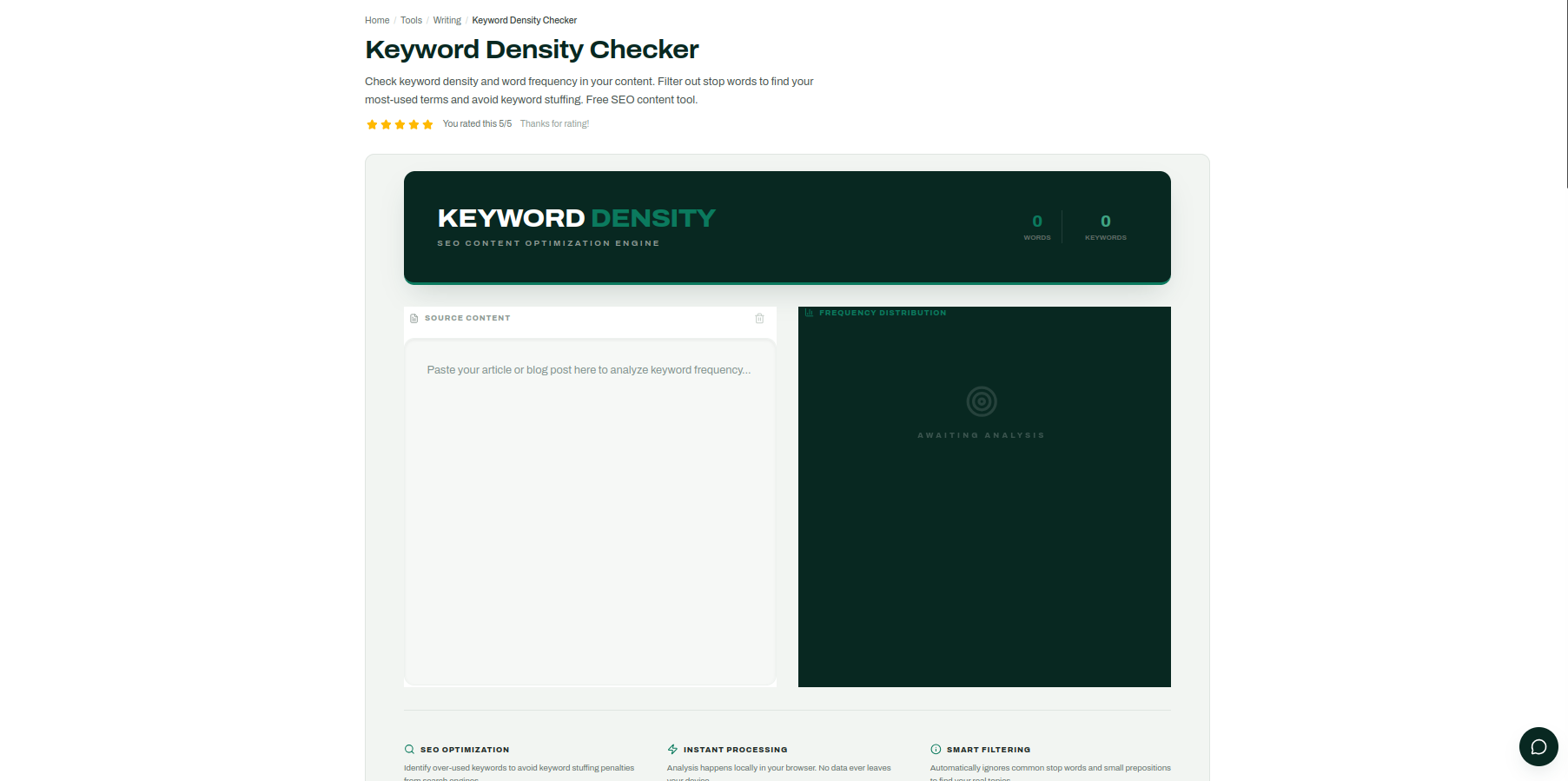
Counting by hand with Ctrl+F works for one word, but it's slow and easy to get wrong. The Wrklyst keyword density checker does it for the whole text at once:
- Paste your article, page copy or draft into the text box.
- The tool counts every word, filters out common filler words, and lists your 12 most frequent words with how many times each appears and its share of the total word count.
- Read the list against your intended topic. If your main term is missing from the top results, the page may not be clearly about it. If one word towers over everything else, read those passages again.
- Use Copy Data to copy the results as plain text (for example,
invoice: 12x (2.0%)) if you want to compare before and after an edit.
The analysis runs entirely in your browser. Your text is not uploaded, which matters if you're checking unpublished copy, a client's draft or anything under embargo.
What the checker counts, and what it doesn't
Knowing how a tool counts stops you from misreading its results. This one is deliberately simple:
- Single words, not phrases. It ranks individual words, so "invoice template" shows up as "invoice" and "template" separately. To check a phrase, count it with Ctrl+F and use the formula above.
- Words of four letters or more. Short words are skipped so that "the", "and" and "for" don't fill the list. The catch: a short keyword such as SEO, PDF, CSS or app will never appear in the results. If your main term is three letters or fewer, count it with Ctrl+F.
- A filler-word list. Common words like "with", "that", "this", "from", "your" and "have" are excluded from the ranking as well.
- Percentages use the full word count. Filtered words are hidden from the list but still count toward the total, so the percentages match the standard formula.
- Punctuation splits words. Hyphenated terms and contractions are split at the punctuation, so "e-commerce" counts as "commerce" (the "e" is too short to show).
A worked example
Say you've written a 700-word guide titled "How to Write an Invoice" and run it through the checker. The top of the list reads:
| Word | Count | Density |
|---|---|---|
| invoice | 31 | 4.4% |
| payment | 9 | 1.3% |
| client | 8 | 1.1% |
| details | 6 | 0.9% |
"Invoice" at 4.4% is a signal to read the draft again, not proof that something is wrong. In this case, the repetition comes from sentences like "Your invoice should include an invoice number, and the invoice date should appear near the top of the invoice." Rewritten as "Put the invoice number and date near the top", that one sentence drops from four uses to one, without losing any meaning.
After a pass like that across the whole article, "invoice" might settle around 2%. The page is still obviously about invoices. Meanwhile, related terms such as "payment terms", "due date", "tax" and "line items" do more of the work. Those related terms help a page more than raw repetition of one word, because they show the page covers the topic in depth.
How to fix a density that's too high or too low
If your keyword is overused
- Use pronouns. After you've named the subject in a paragraph, "it" and "this" usually read better than repeating the term.
- Be more specific. Replace a generic repeat with the specific thing you mean: "the due date" instead of "the invoice" when the sentence is about the due date.
- Cut boilerplate. Repeated intros, summaries and calls to action often account for a lot of the repetition. One clear summary is enough.
- Check headings. A keyword in every H2 adds up fast and reads mechanically. Headings should describe their section.
If your keyword barely appears
- Put the main term in the title, the first paragraph and at least one heading, where readers look first to confirm they're in the right place.
- Use the words your readers would search for. If you wrote "billing document" throughout but people search for "invoice", say "invoice".
- Don't chase a number. One clear use in each important spot beats ten forced ones.
Keyword density vs what actually helps a page rank
Density is a check on how a page reads, not a ranking strategy. What moves rankings is whether the page answers the searcher's question better than the alternatives. In practice, that means:
- Matching search intent. Someone searching "keyword density" wants an explanation; someone searching "keyword density checker" wants a tool. Write the page the searcher expects.
- Covering the topic fully. Answer the follow-up questions a reader would have next.
- Readable writing. Short sentences, clear headings and plain words keep readers on the page. A readability checker flags long sentences and dense paragraphs; our guide on why readability scores matter for SEO explains what the scores mean.
- Accurate, clean copy. Typos and grammar slips cost trust. Run a final pass through a grammar checker.
There is no minimum word count either. A page needs to be as long as its answer, and no longer. Padding an article to hit a word target tends to raise keyword density without adding anything a reader wants. Use a word counter to track length if a brief requires it, not as a ranking target.
Frequently asked questions
Is keyword density a Google ranking factor?
Not as a target percentage. Google doesn't reward a specific density, but its spam policies treat unnatural, manipulative repetition as keyword stuffing, which can hurt a page. Density is best used to spot that problem, or the opposite one of never naming your topic.
What is the ideal keyword density for SEO?
There isn't one. Natural writing about a single topic usually puts its main term somewhere between 0.5% and 2%, but that is a description of normal writing, not a goal. Read the page aloud; if a phrase sounds repetitive, it is.
How do I calculate keyword density?
Divide the number of times the keyword appears by the total number of words, then multiply by 100. Twelve uses in 600 words is (12 ÷ 600) × 100 = 2%.
Does keyword density include stop words?
The total word count should include every word, stop words included. Tools usually hide stop words from the results list so that words like "the" don't dominate it, but they still belong in the denominator.
Is my text uploaded when I use the keyword density checker?
No. The Wrklyst checker counts words in your browser, so the text you paste never leaves your device.
Ready to check a draft? Paste it into the free keyword density checker and see your top words in seconds.
- #guides
- #writing-tools
- #seo
Last updated
October 21, 2026